 VR Game Development
VR game design and development
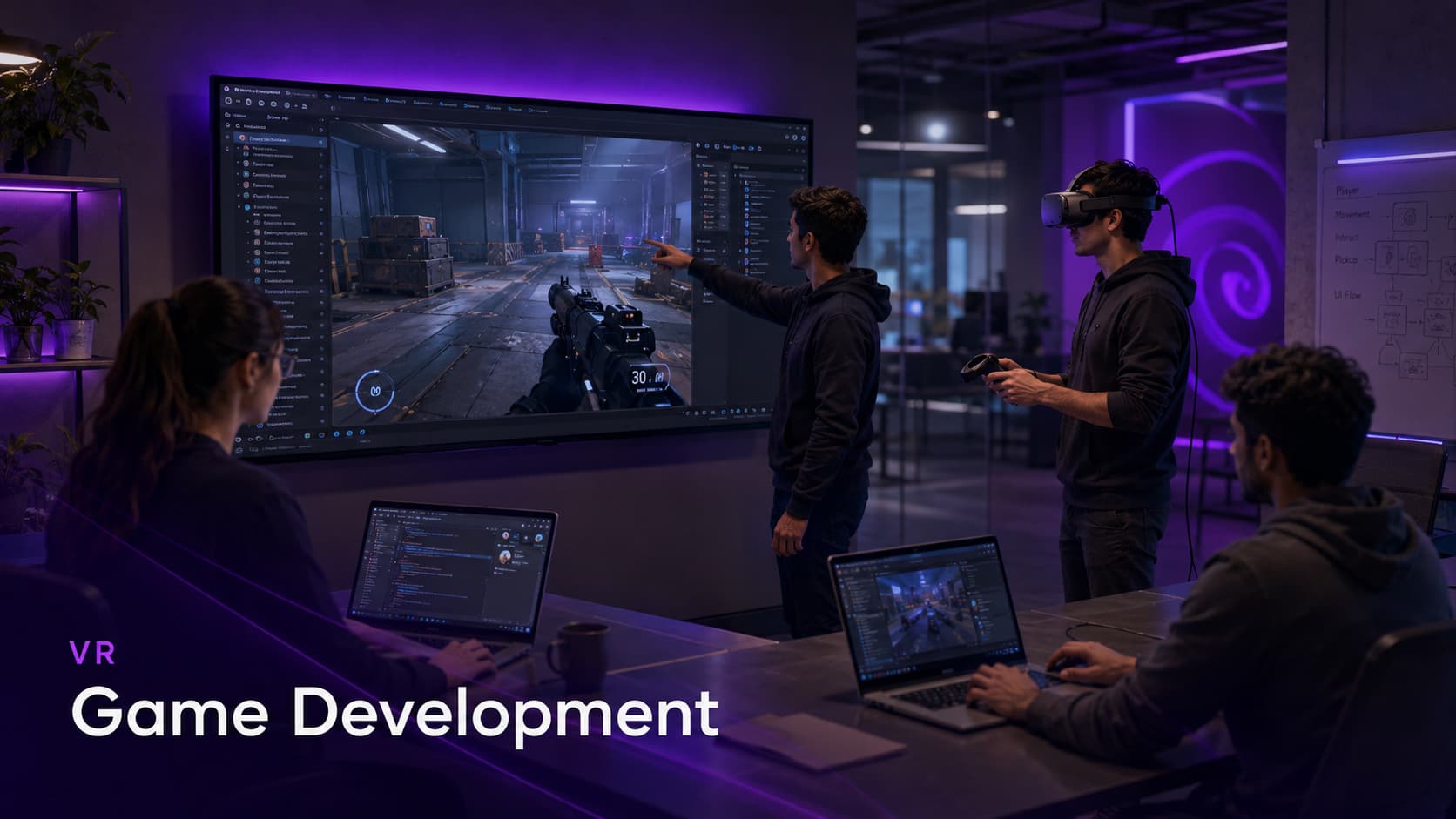
A VR experience needs more than a 3D environment: natural interaction, pacing, and user comfort are essential. VR Game Development, developed by Metanoya within the YMOND ecosystem, addresses this need. It combines game design, interaction mechanics, 3D environments, and user experience for a specific headset and scenario.
- Specialized department
- Metanoya
- Scope of application
- Game development, gamification, and entertainment
What exactly does this solution solve?
This solution is intended for entertainment and education clients, experience centers, and game publishers. It is suited to entertainment games, interactive exhibition experiences, and serious games in VR. Implementation is tailored to each client's goals and operating conditions.
Start with the real problem: what does the end user need to do, which steps are difficult, what information or equipment is available, and how will success be measured? It combines game design, interaction mechanics, 3D environments, and user experience for a specific headset and scenario. Defining these needs guides feature design and helps avoid unnecessary development costs.
The service responds to the need for an experience in which the user has direct presence and interaction with the 3D world. Compared to linear content, a VR game/simulator can make motion, controller, and environmental feedback part of gameplay or training.
Applications and use cases
- Entertainment game
- Interactive simulator and serious training
- Play freely in VR Arena
- Industrial or safety simulation. Maroon Fire Exemplary Project Demonstrates VR Training for Jetfires and Gas Leaks in Petrochemical Refurbished Space
Key capabilities and components
- Immersive 3D environment, motion interaction, game/training/event design and optimization for headset and performance space. Targeted platforms include stand-alone headsets, PC-connected headsets, room-scale/free-roam environments, and seated simulator experiences.
- Combining world design, movement, controllers, sound and environmental feedback with headset and performance space optimization
Core features, modules, and custom options are agreed during each project's needs assessment. The capabilities listed here describe the possible scope; they are not all necessarily included in a single package.
How the solution is experienced or implemented
Determining the target and the user
Implementation and optimization of build
Test of comfort, performance and safety of physical space
Then delivery of demo or agreed version
Technology, requirements and project output
Technology and technical requirements
- Unity engine is supported. Checkable hardware platforms: standalone and PC-tethered headset
- Room-scale space, multi-user free-roam and seated simulator. The headset model, operating system, PC/GPU minimum, tracking system, motion rig and Unity/SDK version must be determined for each project from the approved technical document.
- Offline or local area network (LAN) implementation is supported based on project requirements. This option can be used to play together in a certain space
- Typical inputs: brief, experience objectives, audience, educational/narrative content, headset specifications, and environment dimensions/layout.
Customization and deliverables
- Configurable for gameplay style, environment, sound, movement, controller, audience, headset and destination physical space
- Design, programming, art and UX move in a harmonious process. Room-scale, free-roam, seated and Unity platform modes are checked based on the project's needs in the scope of execution.
- A SKU or delivery package can be a prototype/demo, custom full game, or optimized builds for the agreed headset/rig and execution environment. The name of the devices, number of builds, source/asset delivery, support and revenue share model should be recorded in the scope and contract.
Before starting, define the business or operational goal, an example scenario, budget and timing constraints, deployment environment, and technical decision-maker. These details help establish a realistic scope and delivery criteria.
Who is this solution for?
Purchasing and implementation may involve technical, training, product, marketing, or operations teams, depending on the intended use. It is suited to entertainment games, interactive exhibition experiences, and serious games in VR. If the problem or access to the necessary data and content is unclear, start with a needs assessment or pilot.
Product image gallery
2 image
Related experience and projects
- Beyond Within; The title introduced in Metanoya's VR collection
How to assess the solution's quality
Before purchasing or developing this solution, agree on the following three acceptance criteria in the technical review, alongside the required features:
- Testing game mechanics and target user satisfaction
- Stability and performance on the target platform
- Phased delivery of playable sample and test fixes
Frequently asked questions
What is the difference between a VR game and a regular computer game?
In addition to gameplay, the VR game requires interaction with the controller or hand, user movement, and proper design of the immersive experience; So the design isn't just about transferring a regular game to the headset
What headsets can be developed for?
Selection of the target headset and implementation hardware should be done at the beginning of the project. Compatibility with each headset model is determined based on the technical test of the same project
Is the educational game also produced?
Yes; In addition to entertainment, Metanoya works on serious and interactive games, and the VR experience can also be designed for practical training or introduction.
How is user comfort and interaction evaluated?
Initial testing on users, clarity of interactions, motion control and comfort of experience are important criteria for VR game quality control.
Why choose YMOND for this solution?
YMOND is a deep tech development group working across AI, computer vision, immersive XR experiences, and interactive hardware. Metanoya is the specialist team behind this solution. Together, these capabilities allow the project team to address each client's challenge through coordinated software, content, and hardware design where needed.
Complementary solutions
How can I request a demo or a tailored proposal?
To explore VR game development for your organization, share your challenge, audience, operating environment, and expected outcomes with the YMOND team. Request a specialist consultation or start with the Vision Plus needs assessment to assess feasibility, discuss customization, and receive a technical proposal.
